

What makes a good (data) product?

Hello Data PMs,
Recently, someone asked this question, and I was left thinking.. how does one summarize this well? So this substack is all about a rough framework for what makes a good (data) product given my knowledge is biased here.
Customer Value x Business Value
At the heart of it, it’s all about delivering (a) customer value so that they feel that your product makes their life easy, and (b) the product must generate business value so that it can become a fuel for other products by directly or indirectly bringing in business value.
And, merging the two so well that the customer feels delighted and the business is on a growth fly loop between various products/product areas. And, how does one do that?
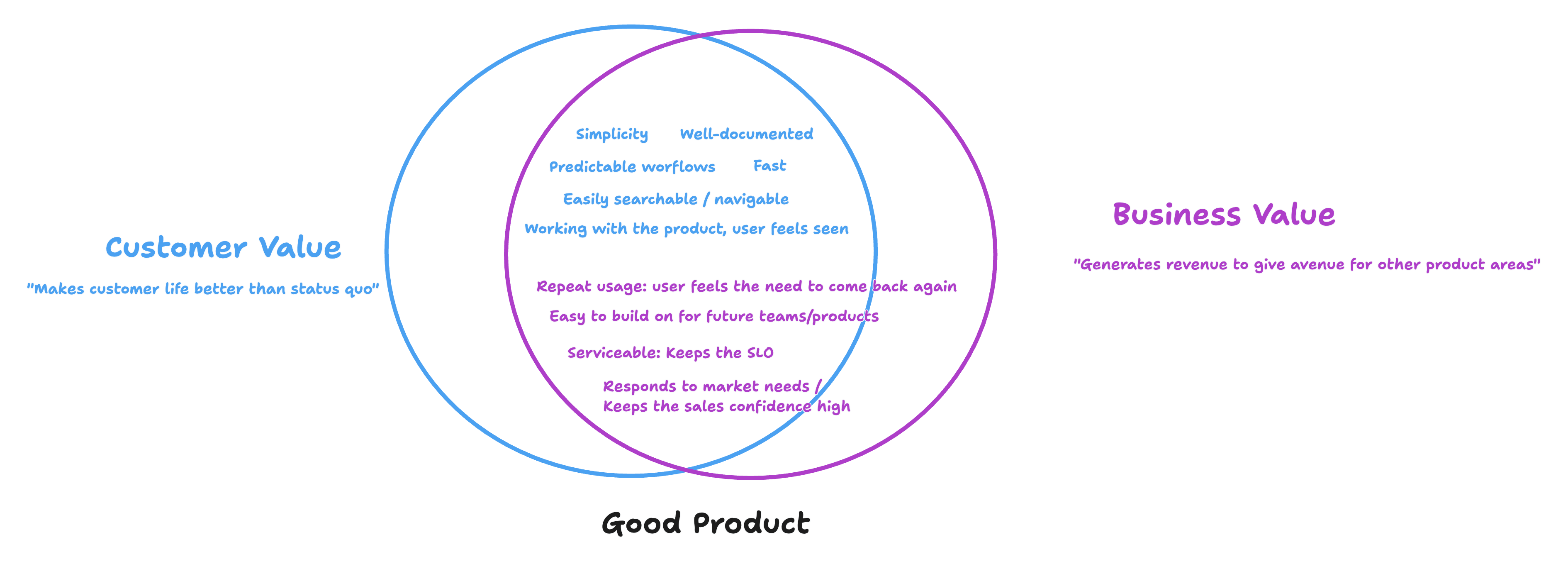
Here’s a list of must-have traits that make a “good product” and can deliver customer value and business value. This list is not exhaustive but is a good starting frame for anyone to think about “what to fix” / “improvements” one can make.
Traits of a good product
From a customer/user perspective:
Simplicity - easy to use, easily understood, and not overwhelming. Highly technical products can be quite simple too.
Predictable workflows - The workflows should be well aligned with users’ ways of working. For eg: if a user is likely to change some settings, preview some things, and, be able to publish their work from a page, they should see those options very evidently. A good metric is the number of dead ends. Basically, pages where no further action is possible and users behave frantically: Fullstory records this as “rage clicks”.
Fast - No one wants a slow product. Period. You should maintain industry standards around Time to First Load, Throughput, Apdex Score, etc.
Easily searchable / Navigable - No one wants to feel lost or stuck, even in a non-emotional product. Therefore, having a good search system to move from Part A to Part B easily, and having an apparent navigation is a key to making your product successful.
Well-documented - However intentionally built your product is, users need extra support understanding some workflows, making choices, and understanding how to best leverage the product.
The user feels seen: At an emotional level, the user feels that the product understands what a user wants/needs. This happens when you have a few features that other products not built with a user-centricity miss.
From a business perspective:
Repeat usage: The user feels the need to come back again - does your product necessitate the need to return when the user has a similar/related task?
Easy to build on for future teams: A good product serves the business if it grows with the business. If the architecture can support higher scales, more users, and is built with the mentality of reusable components so that future development and iterations are faster.
Serviceable: Can Support teams address Support tickets themselves without needing an engineer, and respond with requests related to further enquiry themselves. This is often a big miss to not empower internal teams with the right information (logs/metrics/event streams) to help service the product as needed.
Responds to market needs: You can’t control the market, and therefore, being aware of the market needs and trends will only help grow your revenue and make your product good for the business.
How about for a UX product?
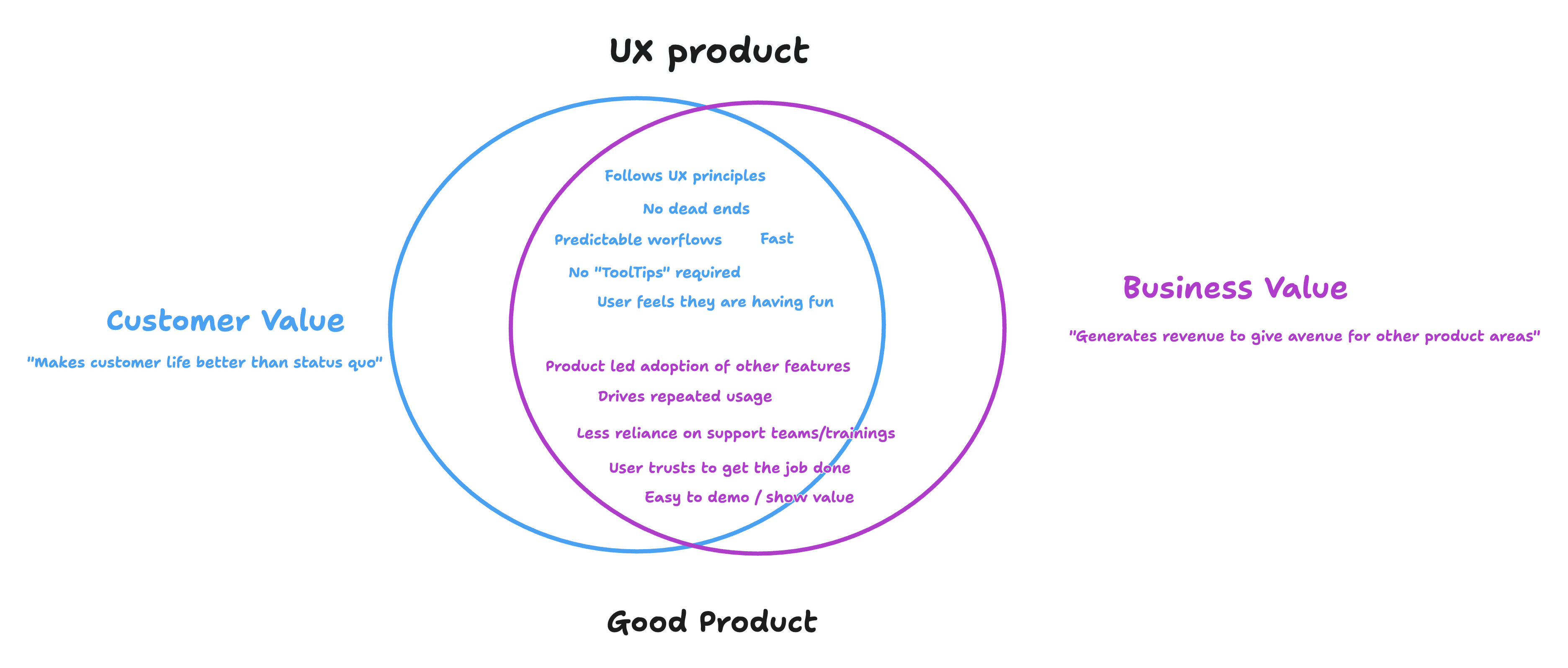
While the above section provides a general frame across both frontend and backend products, these traits can differ slightly for a UX product and a (data) platform product. So, here’s how these traits differ for a UX product:
Customer value
A good UX product, in my opinion, follows UX principles well and leverages behavioral econ techniques that help drive adoption/make workflows sticky & predictable. Here's a reference book that I created to help understand which behavior econ concepts can help with which metric and goal a product person has.
The user should feel seen and should have fun while working with your product, however, technical the product is. Workflows are predictable without a lot of tooltips or help text. And, performance is to the expectation of the user.
Business value
If you build a good experience, it should result in the adoption of other features, so the product doesn’t feel siloed. Your product should encourage repeat usage, and have end-to-end workflow, sometimes, stemming out of the product, using emails/slack alerts that bring a user back to the product. Setting up workflows, data, and onboarding should not feel that they might require 2-3 training or a professional service provider. And, finally, over time users feel that the product gets the job done well, and is growing in the right direction, as the users’ needs are also changing.
How about a Data Platform product?
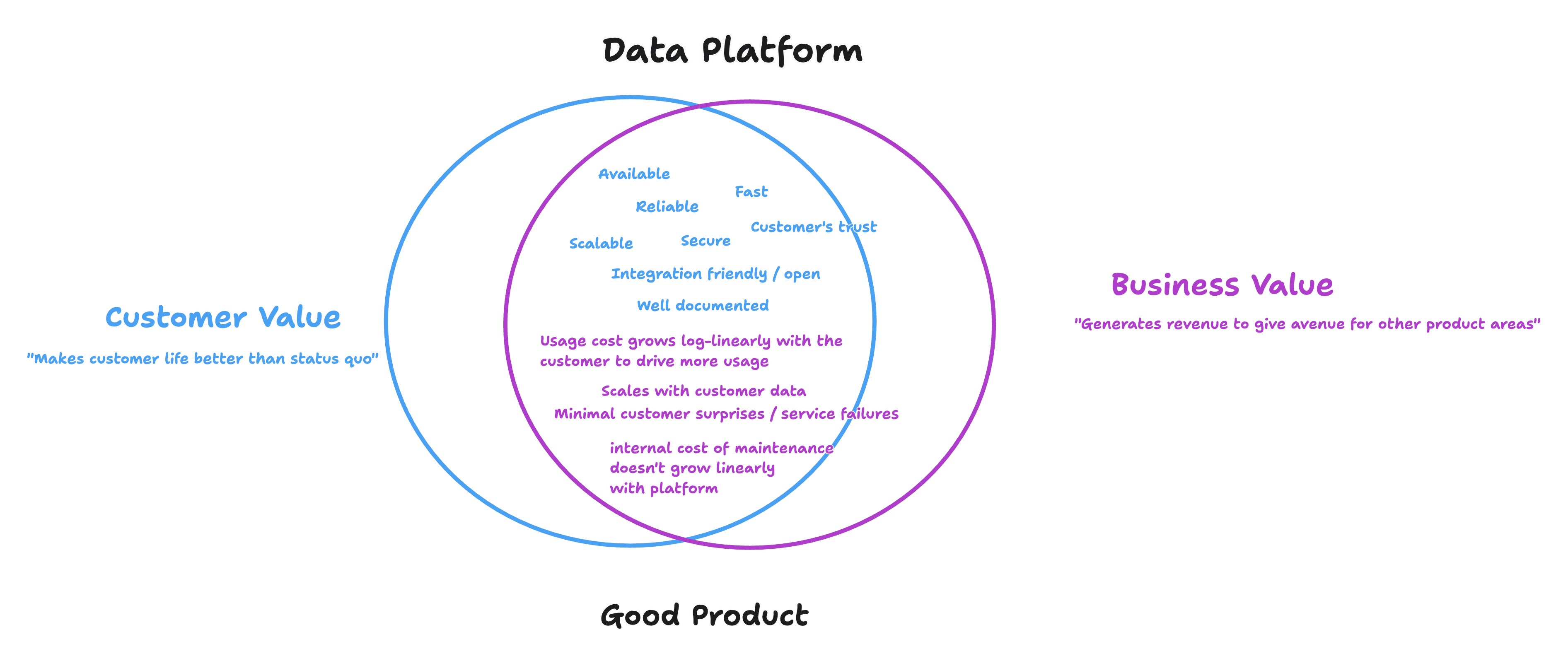
A good Data Platform behaves as a silent powerful engine that no one should care about as their job gets done, without worrying about failures, breakages, or delays. Here's how the traits of a good Data Platform look like that help generate customer & business value:
Customer Value:
For a platform, customer value is really whether it has the right availability, reliability, performance (fast), scalable, security SLAs. Do the customers trust the platform to do the job? Can the customers understand how the platform works with the documentation present?
Business value:
To generate business value, here are a few product traits that a good platform can rely on. Foremost, more usage should not linearly increase the cost for the customers, so they are encouraged to increase usage. The platform should scale with business data, as data only grows over time, and if the platform can’t support it, we might be at a risk of losing revenue. There should be minimal service failures, and the internal cost of maintenance should not grow linearly with the usage of the platform, so we get economies of scale.
I would love to hear what you think makes a good product. What did I miss? Feel free to share your learnings in the comments!
🔗 Links of the month
If you have missed out on Databricks and Snowflake Summits 2024 announcements and don’t know what that means for both of them, hear
’s SiliconAngle commentary here.
If you are building a product portfolio, this might be the most helpful post from
.Following up on my product metrics post, here’s how you measure the impact of a feature by
.

Cheers,
Richa
Your Chief Data Obsessor, The Data PM Gazette.
Thanks for sharing the portfolio piece! Appreciate it.